Available tickets
About this event
The neurobiology of trauma is the same at home and in an institution, but professionals work under different conditions: in groups, within legal and procedural limits, often with several children at once. Responding to an explosive crisis in a classroom or residential unit therefore calls for different tools than at home.
This workshop is grounded in the realities of schools, residential settings and work with families. It focuses on responses to crisis situations, when the safety of the child or others is at risk. Participants will practise how to:
- safely hold a crisis when several children escalate at the same time in a classroom or residential unit,
- prevent group contagion and keep the whole group safe,
- select the right tools for the situation,
- adapt structure and nurture to the child’s attachment strategy (avoidant, ambivalent or disorganised),
- distinguish between responses permitted in institutional settings and tools intended for the home,
- teach foster families safe strategies to use at home.
Part of the day is devoted to case work: participants can bring their own current, challenging cases and work with the facilitator on concrete action plans. Please prepare your case in an anonymised form.
For: teachers and educators, psychologists, social workers, foster care coordinators, family support workers, and staff of residential care settings and adoption agencies.
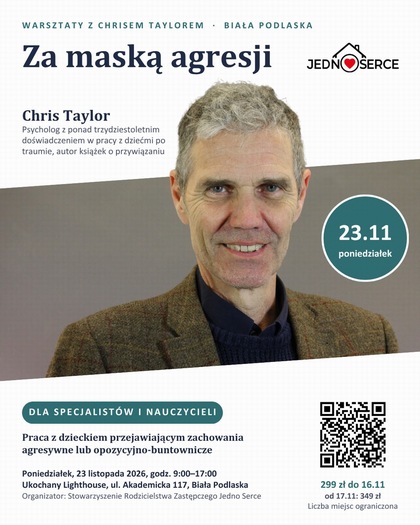
Facilitator: Chris Taylor, psychologist with over thirty years of experience working with children affected by trauma. Author of two books on attachment and trauma published in Polish, including Empathic Care for Children with Disorganized Attachments.